A tiny line of ants crossing a sidewalk can become a whole afternoon of discovery. When children ask where the ants are going, how to observe ants becomes less about finding the right answer and more about slowing down together. A garden path, a crack beside the porch, or a fallen crumb can reveal a busy little world already at work.
Ants are wonderful neighbors to notice because they are active, organized, and full of surprises. With a little patience, children can watch them carry, touch, turn, follow trails, and disappear into their hidden homes. The best part? This small outdoor adventure needs almost no equipment.
Begin With Gentle Eyes and Quiet Feet
Before looking closely, help children understand that observing means watching without interrupting. Ants may be small, but they are busy caring for their colony, finding food, and communicating with one another. We can be kind visitors.
Choose a dry day and look near sidewalks, tree roots, garden edges, patios, or open patches of soil. Ants are often easiest to spot when the ground is warm. Invite your child to crouch down nearby rather than standing directly over the insects. Quiet feet and calm hands make it easier to see what the ants do naturally.
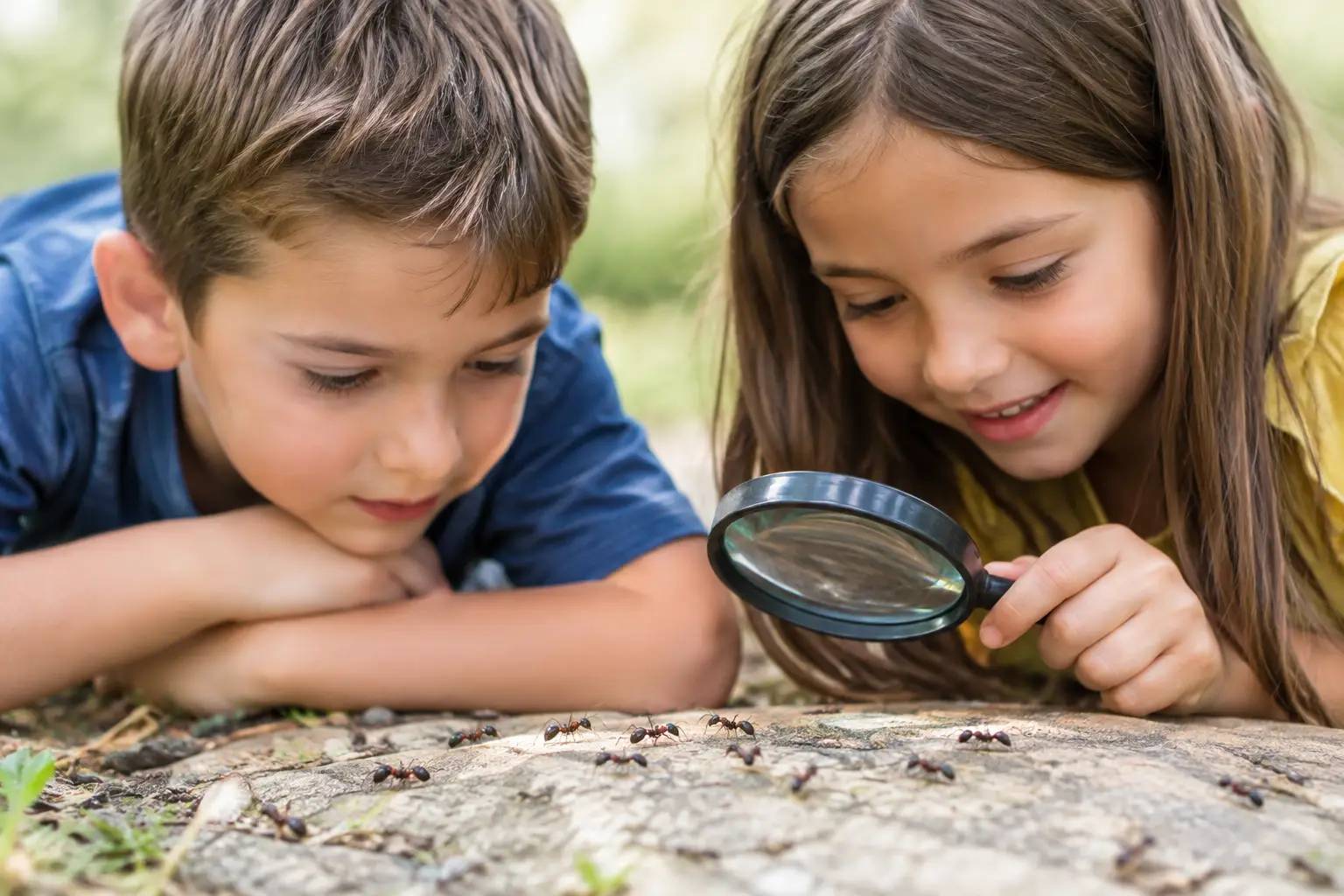
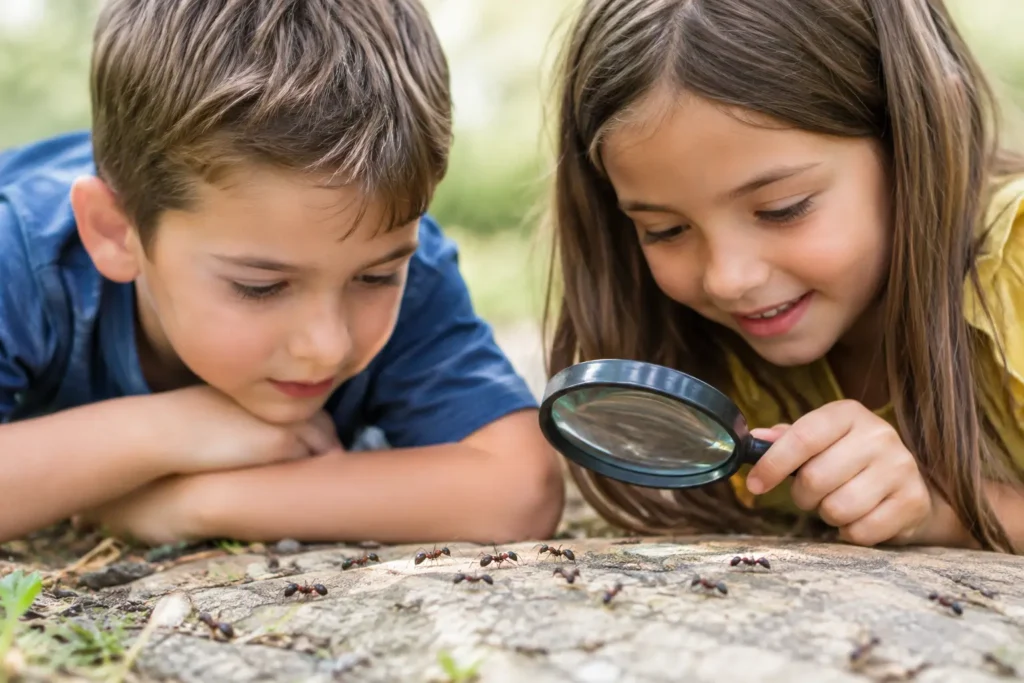
A simple magnifying glass can make the experience feel extra special, but it is not required. Children can observe plenty with their own eyes. If you use a magnifier, hold it above the ant rather than trying to trap the ant underneath it. Let the ant choose its own path.
What to Notice When You Watch Ants
There is no need to turn an ant walk into a lesson with right and wrong answers. Begin with a wondering question: “What do you notice?” Your child may see an ant carrying something larger than its body, another ant moving quickly in circles, or two ants pausing as if they are saying hello.
Encourage close looking at the ant’s three main body sections: the head, middle section, and abdomen. Can your child spot the antennae reaching forward? Ants use their antennae to touch and smell the world around them. When two ants meet, they often tap antennae. It may look like a tiny greeting, but it is also one way ants share information.
Notice the trail, too. Are the ants walking in a line, or are they spreading out? Ants leave scent trails that can guide other ants toward food or back to the nest. We cannot see those scent messages, but we can see their effect when more and more ants begin to follow the same route.
A child does not need to know scientific names to make an excellent observation. “This one has a shiny body,” “They keep going under that leaf,” and “That ant is carrying a crumb” are all meaningful discoveries.
Make a Tiny Ant Observation Spot
If you would like to watch for a few more minutes, choose a safe place a few feet away from an active trail. Sit on a blanket, a low step, or the grass. Avoid blocking the ants’ route or digging near their nest.
You can place a small natural landmark beside the trail, such as a pebble or a leaf, without putting it in the ants’ way. This can help children see how the ants travel around familiar objects. Then simply wait. Ants may pause, change direction, or find a new route around the obstacle.
It is best not to leave food out for ants. A crumb may bring a crowd quickly, but it can change their normal behavior and may attract other animals or insects. The most interesting observations often come from noticing what the ants have already chosen to do.
For young children, five quiet minutes can be plenty. Older children may enjoy returning to the same spot at different times of day. Do the ants appear more active in the morning or afternoon? Has the trail changed after a rainy day? Little comparisons help children recognize that nature is always changing.
Turn Questions Into an Ant Adventure
Questions keep the experience playful. Rather than explaining every detail, offer one or two prompts and give children time to think. They may invent ideas, revise them, and notice something new. That is how curiosity grows.
Try asking: “Where do you think this ant is going?” “What do you think it is carrying?” “What happens when two ants meet?” and “Can you find the place where they disappear?” If a child asks a question you cannot answer, you can say, “Let’s keep watching and see what clues we find.”
Some ants are fast, while others seem to wander. Some are dark brown or black; others may look reddish. This is a lovely chance to explain that not all ants are the same. Different kinds of ants live in different places and have different habits. You do not need to identify every one. Noticing differences is enough.
A Simple Nature Notebook Activity
After observing, bring the adventure indoors or settle under a shady tree with paper and crayons. Ask your child to draw the ant trail they saw. It does not have to look realistic. A wiggly line, a nest entrance, a leaf, and a few tiny dots can tell the story beautifully.
Adults can write down a child’s words beside the picture: “The ants made a road under the flowerpot,” or “They touched their feelers.” This turns a fleeting outdoor moment into a keepsake and gently connects nature observation with early writing.
For a class, family, or homeschool group, invite everyone to make one page for a shared ant book. One child can draw what ants carried, another can draw the nest area, and another can create a page called “Questions We Still Have.” A poem or a made-up ant marching song can make the memory even more joyful.
At Abel & Ruth Children’s Discovery Series, these are the moments we treasure: a child noticing a creature nearby, sharing an idea, and realizing that the backyard is full of stories waiting to be found.
Keep Ants Safe and Children Comfortable
Respect is part of every nature adventure. Teach children not to pick up ants, poke into nests, spray water on trails, or stamp near where ants are working. Some ants can bite or sting when they feel threatened, and a disturbed nest can bring many ants out at once.
Watch from a comfortable distance, especially if you see a large group entering a hole in the ground or climbing on a structure. If ants crawl onto clothing, brush them off gently rather than swatting. After outdoor play, washing hands is a good habit, particularly before snacks.
It also helps to remind children that ants are not “good” or “bad.” They are animals doing the work they need to do. Sometimes ants belong outdoors, even when we would rather not find them near a picnic blanket. This gentle perspective builds empathy while still leaving room for practical family boundaries.
How to Observe Ants Through the Seasons
Ant watching changes with the weather. In spring and summer, trails may be easier to find as colonies gather food and care for young. After rain, you might see ants rebuilding paths or moving around damp ground. On hot days, look in cooler, shaded places as well as sunny paths.
In cooler months, ants may be much harder to spot. That is not a failed nature walk. Search for old nest entrances, tiny soil piles, or places where ants were active before. Children can remember, draw, and wonder about where the colony may be resting. Nature has quiet chapters, too.
The next time a small ant crosses your path, pause before hurrying on. Get low, look closely, and let your child lead with a question. A few patient minutes can make an ordinary patch of ground feel wonderfully alive.